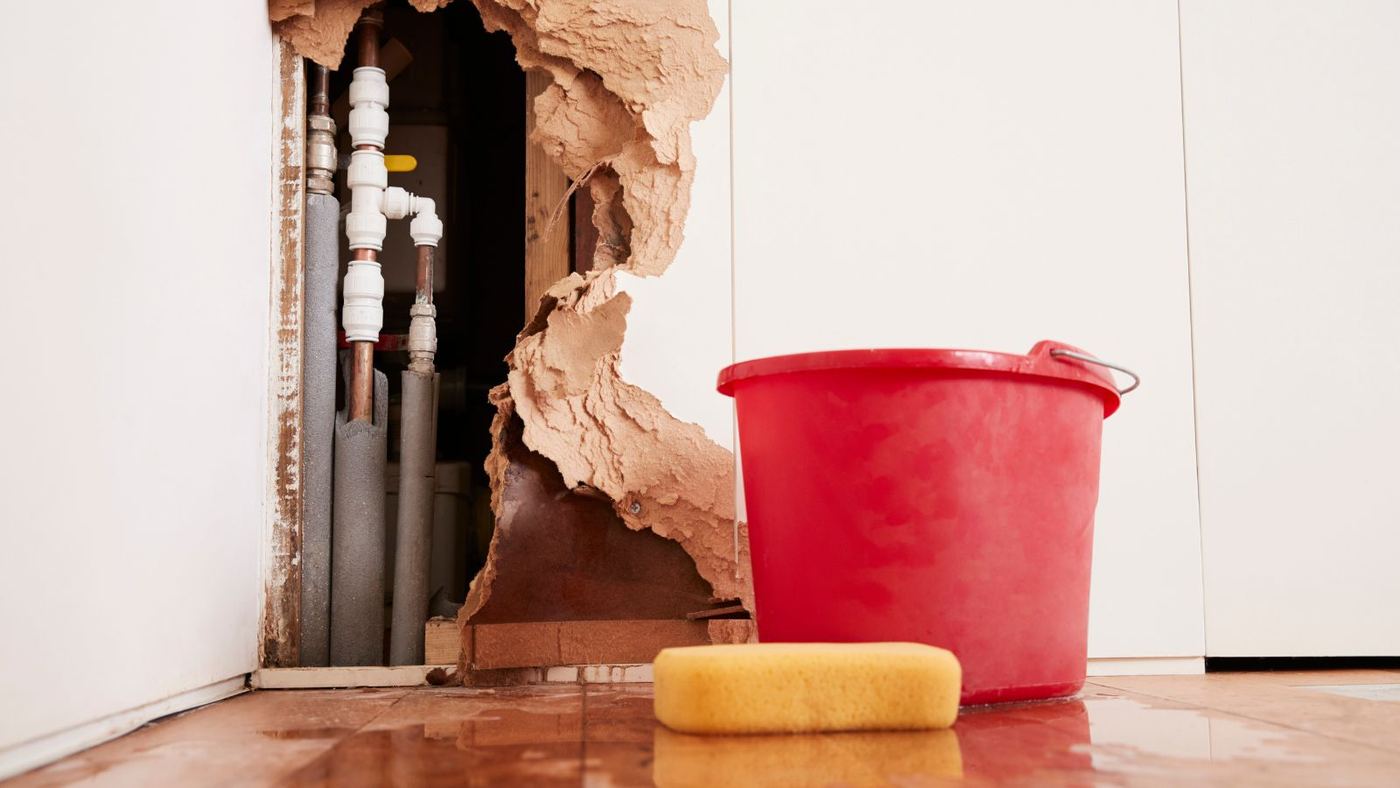
How a burst pipe happens in Culver City homes
Pipes rarely burst because of cold in this part of Los Angeles County. They fail because they are old, corroded, over-pressured or knocked loose during other work. The city's Multi-Jurisdictional Hazard Mitigation Plan, in its housing section, reports that roughly 87 percent of Culver City's housing units were built before 1980, using 2013 housing data. Older buildings often still carry original supply lines in walls and under floors.
A supply line under pressure can spray, or it can leak inside a wall for days before a stain appears. A fitting at a washing machine, a toilet connector or a copper pipe pinhole behind a vanity can look small and still do large damage when it runs overnight.
What you see and what it usually means
Symptoms point to where the water is and how far it has traveled.
| What you see | What it often means | First move |
|---|---|---|
| Water spraying or pooling at a fixture. | A failed connector or fitting. | Close the fixture valve or the main. |
| A wet wall with no visible source. | A pinhole or loose joint inside the wall. | Close the main and call for moisture mapping. |
| A ceiling stain that grows. | A supply line or drain above the ceiling. | Close the main and avoid standing under the stain. |
| A water meter that keeps moving. | A leak somewhere past the meter. | Turn off the main and call a plumber and dispatch. |
| Warped baseboards after a quiet night. | A slow leak that ran for hours. | Photograph, close the main, call. |
First hour safety steps
Do these before anything else, in this order.
- Close the main water shutoff valve, usually near the street side of the house or at the meter box.
- Turn off power to wet rooms at the breaker if you can reach the panel without stepping in water.
- Stay out of rooms where water is touching outlets, cords or appliances.
- Open faucets at the lowest point of the house to drain the lines once the main is closed.
- Call a plumber for the pipe and call dispatch for the water.
Who fixes what
Golden State Water, which serves the Culver City system, maintains water lines only up to the meter, and its Culver City page lists a customer line at 1-800-999-4033 that is open around the clock. A burst on your side of the meter is the property owner's to repair, so a plumber fixes the pipe. We handle the water that came out of it.
The Building Safety Division's published permit list says stopping leaks and clearing clogs without replacing pipe needs no permit, while water piping that is new, replaced or extended does. Ask your plumber which one applies before the wall is closed.
How the cleanup runs after a burst pipe
The work follows the same order whether the pipe burst in a kitchen or a second-floor bathroom.
- Stop and secure. The crew confirms the main is closed, checks for electrical hazards and photographs the affected rooms.
- Extract standing water. Pumps and wet vacuums pull water from floors, and carpet may be lifted so the pad can be removed.
- Map the moisture. Moisture meters and a thermal camera show which walls, subfloors and ceilings are holding water.
- Open what is wet. Baseboards are removed and wall cavities are opened where readings call for it, so air can reach the framing.
- Dry and monitor. Air movers and dehumidifiers run for days while readings are logged until the structure reaches dry standards.
Water still coming from a pipe?
Call the 24/7 line now. Close the main first if you can.
What changes the cost of a burst pipe job
Cost depends on how long the water ran, how many rooms it reached and what the water touched. A short leak on a tile floor is a different job from a leak that traveled down through a ceiling into the room below.
Other factors are the floor type, whether insulation is wet, how many days of drying equipment the readings call for and how much rebuild is needed afterward. A crew explains the scope and price on site before work begins, and a web page cannot quote a number honestly.
Insurance and burst pipes
Sudden and accidental pipe failure is often treated differently from a slow leak that went unnoticed for weeks. Policies vary, so read yours and ask your insurer what it covers. The California Department of Insurance lists wear and tear among the perils that are usually excluded, so the cause matters.
Photograph the pipe, the water and the damage before cleanup, keep the plumber's invoice and ask us for the moisture readings and scope. Those records support your claim. For more on how losses are documented, see our water mitigation page.
Mistakes to avoid after a burst pipe
These choices cost homeowners time and money.
- Waiting to see if the stain stops growing before closing the main.
- Running a household vacuum on wet carpet or standing water.
- Closing up an opened wall before it has been read dry.
- Throwing away damaged materials before photographing them.
- Assuming a dry surface means a dry wall.
Serving Culver City and Marina del Rey
Crews work across all 15 recognized Culver City neighborhoods and drive west for calls in Marina del Rey. The service areas page explains coverage and how to confirm your address.
For standards, the reference most restoration companies follow for water work is ANSI/IICRC S500, and you can ask any company whether its crews work to it. After the pipe is dealt with, water damage repair covers the rebuild.
Burst pipe questions from Culver City homeowners
Yes. The line is staffed day and night, holidays included, and a crew is sent the same day when one is free. You are told plainly what to expect.
Close the main valve, then call both. The plumber repairs the pipe and we remove the water and dry the structure, so the two jobs happen side by side.
It depends on the materials and how long they were wet. Drying commonly runs several days, and readings decide when it is done.
Sudden and accidental pipe failure is often covered, and gradual leaks often are not. Your policy and your insurer decide, so ask before repairs begin.
Stopping a leak without replacing pipe does not need one according to the city's list, but new or replaced water piping does. Confirm with the Building Safety Division at (310) 253-5800.